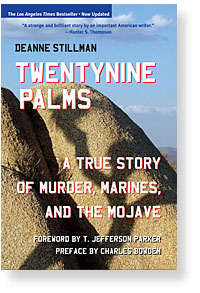


The approach to the Mojave town of Twentynine Palms is a long, dusty parade route of fraternal lodges, cheap motels, and cross streets with names that beckon – North Star and Lupine and Ocotillo – and front yards with pit bulls that tell you to forget about it. Then, the town itself, split in half by the age-old conflict of violence and beauty: north of the main drag is the world’s largest Marine base; south is Joshua Tree National Park, sanctuary for freak-show plants and extreme geography.
In the shadow of this military outpost and against a panorama of spectacular desert scenery camps a roiling brew of latter-day tribes: blackguards and exiles, run-away kids, prospectors, retirees, asthmatics, descendants of early pioneers, bikers, hikers, Crips, Bloods, skinheads, Samoans, methamphetamine chefs, people who worship intently at the altar of personal rights.
In 1991, it all collided: two young girls were savagely murdered by a troubled Marine who had recently returned from the Gulf War. One was about to turn 16, the other 21. How did these girls come to find themselves in a certain apartment on a certain night in Twentynine Palms? What family and cultural legacies dogged them and ultimately sealed their doom? How are America’s children faring in the shadow of military outposts where dwells those who are sworn to protect the country?
Exquisitely and inexorably, Deanne Stillman uses this tragedy as a prism through which she explores not only the murders and the families involved, but a rootless culture of fatherless families, shattered dreams, and relentless violence. In haunting, vivid prose, she creates a far-reaching story of America itself, carrying us into the empty white heart of the Mojave, as we meet and come to know the modern nomads who turn to the West for salvation only to be devoured by its false promise.

“This is a strange and brilliant story by an important American writer.“
— Hunter S. Thompson
“A book as stunning as it is shocking. In Stillman’s prose, you can almost feel the blistering heat of the Mojave Desert, smell the stale beer of the seedy bars... This book is unforgettable.“
— Arizona Daily Star Sunday Book Review
“This haunting desert-gothic tale will remind some of Joan Didion and Raymond Chandler, but the beautiful relentless intensity of Deanne Stillman’s personal engagement with this emblematic crime story gives it a stunning originality. It’s an irresistible plunge into a palm-fringed nightmare.“
— Ron Rosenbaum, author of Explaining Hitler
“Stark observations of beer and crack-fueled parties among jarheads and townies...A fascinating, if chilling read.“
— Maxim
“Twentynine Palms is one of the best stories to ever come out of the high California Desert, a tale of poverty and violence and Marines gone bad in a place where the Hell’s Angels are a girl’s best friends. Stillman has written a terrific book, and an important one, painting a picture of American life, post-Desert Storm, that is just shy of apocalyptic.“
— Judith Freeman, author of Red Water
“Blows readers away...with the blood and guts and heart of the murder.“
— Austin Chronicle
“Deanne Stillman makes us finally face how many Americans live and die and keep on living lives that we know in our bones are DOA. The place, a desert of wind howling with twelve packs of loneliness. The people, lost souls driven into an American graveyard outback of the West Coast’s celluloid dreams. This the Great American Desert where the sun has yet to shine.“
— Charles Bowden, author of Blues
for Cannibals:
The Notes from Underground
“Good news for readers who’ve been waiting for a book to match In Cold Blood.“
— East Bay Express
“Whew! Stillman writes a dust-devil tale of murder, madness and the military soaked in white-hot passion and razor-sharp insights. Not since Raymond Carver weaved down his strip of motels and trailer parks has anyone dared the high-wire act of writing the low-life and carried it off with such ease.”
— Lucian Truscott, author of Dress Gray
“Stillman immerses herself and her reader in a world at which few desire even to peek, depriving both of cliche.“
— Los Angeles Weekly
“To writer Deanne Stillman’s enormous credit, her new book focuses less on the murderer than on the sad, awful world of the murdered girls...Even trickier, she makes you care.“
— Pages Magazine
“Stillman’s conscientious research and stylistic verve make Twentynine Palms an engrossing read, well above most true-crime stories.“
— Washington Post
“A haunting and evocative journey to strange yet recognizable terrain.“
— Los Angeles Times Book Review
“[Stillman’s] writing and reporting skills are excellent.“
— Sunday Oregonian
“Highly recommended for all public libraries.“
— Library Journal
“Twentynine Palms whispers and it shouts and it cries. It shows loneliness and how it turns to murder. It's about a place in the California desert, but it's also the place in every town where living and dying are balanced on the edge of emptiness. Deanne Stilman knows that place and its people, their longing and their hurt.“
— D.J. Waldie, Holy Land: A Suburban Memoir
Q:Why did you write Twentynine Palms?
A: : I’ve always loved the desert. And, because of certain things that unfolded during my childhood, I’ve always had an affinity for the people, in particular, the kids, whose stories go untold, unappreciated. The story of the two girls killed in Twentynine Palms was IT for me; every theme I’ve ever loved and responded to was right here in this one grisly moment. The real question is, was there anything that told me NOT to write it? The answer is a resounding no.
Q: How long did you spend writing the book?
A: The whole process took nearly ten years, for various reasons. There were six years of trial delays so I couldn’t really finish until the trial was concluded. But the delays suited me, anyway. I ran out of money several times, had to strangle Peter in order to pay Paul; also, thanks to the generosity of some benefactors in the form of friends and relatives, I was able to carry on. The story was extremely disturbing and there were times I had to get away from it. There were times I felt I wasn’t up to the task of telling this story of the rootless kids who wash up in Twentynine Palms, not to mention doing justice to the sad, heroic lives of Mandi Scott and Rosalie Ortega, the two murder victims.
Q: Can you talk a bit about some things that happened while you were working on Twentynine Palms?
A: The subject matter is volatile. Some people did not want me to tell this story. Several merchants in the town of Twentynine Palms were quite upset when an article I wrote about the incident was published in Los Angeles Magazine in April, 1996 (it won a Maggie Award for best news story of that year). The local newspaper, The Desert Trail, ran a series of editorials excoriating me in the most vitriolic way, orchestrated a letter-writing campaign of school children to Los Angeles Magazine, and accused me of “crucifying” the town. Also, after my article appeared, the killer’s lawyer subpoenaed my notes (at the time five or six years’ worth).
Los Angeles Magazine, then owned by Capitol Cities/Disney, feared an expensive legal battle and encouraged me to turn over my notes. I called the head of the Cap Cities legal department and threatened to “alert the media” about this threat to my rights under the First Amendment. Which I did, tipping off Bill Boyarsky at the Los Angeles Times about the situation. He wrote a piece on the front page of the Metro section and around the same time Los Angeles Magazine decided to fight the subpoena. After two or three months in pre-trial hearings, we won the battle and I was not asked to turn my notes over to the prosecution.
Other obstacles thrown into my path include the Naval Criminal Investigative Service (the CIA of the Marine Corps) calling me at home. This was scary because usually it’s writers who call government agencies first, not the other way around. And then weirdly, I was chased out of the UCLA petroglyph archives by the head of the anthropology department. I had gotten permission from a docent to view a CD-ROM which featured pictures of ancient Indian rock art on the Marine base at Twentynine Palms. The government had commissioned UCLA to do the survey. After some time, the anthro head wandered through the aisles and asked what I was up to. I explained and she shut down the computer and asked me to show her my notes! I refused and then she ordered me to leave the campus! I had expected flack from the Corps and even some locals, but the UCLA rock art archives? That was strange....
Also, there’s the much more personal challenge of the whole thing. Ten years of research and I came to know people quite well. Joan Didion once said, “writers are always selling someone out.” All too true and disturbing. Yet the only thing to do is live with it.
Q: Did you always want to become a writer?
A: Yes. I’ve been writing since I was a little girl. My parents were both literary-minded and taught me to read well before I began attending school. From my mother, I received my knowledge of children’s classics such as the Eloise and Madeline series, Charlotte’s Web, and Alice in Wonderland. She continues to guide me to various works that have been key in my life. My father and I would make up characters and plays, often based on current events. He also read aloud from his favorite writers, including John O’Hara, Hemingway, Sean O’Casey, and he would repeat verbatim the monologues of his favorite comedians. He also had instant recall of a zillion bar jokes and anecdotes. But the one writer whose work influenced me the most at that time, and in certain ways, over the years, was Edgar Allan Poe. My father often recited his poems and short stories. In particular, I would cite the poem Eldorado, with Poe’s haunting cadences and images, as a major influence on my work and life, especially as it fused over time with my love of open space and the condition — both spiritual and geographical — of wandering.
Q: How did your first writing get into print?
A: My father and I loved to read Mad Magazine when I was a kid. It was the only magazine that made sense of the absurdity of the world. It seemed to me it was a possible venue for my sketches and parodies, written in the shaky hand of an eight-year-old. And so began my first submissions to the publishing world, under the name “Dean” Stillman, as I noticed that there were no girls contributing to Mad. Actually, these submissions resulted in my first experience with the ghastly editorial phrase “not right for us.”
Later, in college and for a few years after, I began writing for the underground press — The Berkeley Barb, The Los Angeles Free Press, The New York Ace, and then, Screw (which I think was the first place that paid me for my work, a piece I wrote under a pseudonym called “Henry Kissinger’s Middle East Position”), The Village Voice, High Times, and some of the funkier men’s magazines (not dependent on the beauty industry for ads, those mags did not have to — and still don’t — fill pages with stuff like “Nine Ways to Make Your Mascara Last,” and therefore have more space available for different kinds of writing).
The underground press, and sex and drug mags were a great training ground for writers and journalists who wanted to develop their own voices, who never believed in the “5-W” school of reporting as a way of conveying the truth or, for that matter, even lies of interest, for scribes who today recoil at the obsession with celebrity so-called journalism and who wanted to rage against the machine, unfettered, not on op-ed pages of major newspapers. Of course today, the underground press has morphed into the “alternative” press, and in some cases, actually is. Yet the celebrity obsession prevails, and what these papers have to say, generally, carries little weight.
Q: Did you encounter much rejection? Did you learn anything about dealing with it?
A: Rejection is always hard to take and I’ve encountered my fair share. But over the years, I’ve gone from crying to “the editor is an asshole” to reminding myself that a buncha assholes turned down Moby Dick to simply not taking it too personally. One of the worst things about rejection is the starvation factor. Yay, happy hour is all I can say — a key factor in my formative years!
Q: Did you take writing classes?
A: Not formally. By that I mean I spent time with a circle of writers who served as a kind of class in writing. Although the circle changes over time, the function is the same. Also I have always read a lot. That being said, I think some writing classes can be quite valuable, depending on whether or not the word “critique” is used. On the other hand, what’s up with all this “journaling”? This is a weird animal that has crawled out of the self-help/rehab movement and belittles good writing and people who have devoted their lives to the art.
Q: Does writing come easily to you? Do you revise much?
A: Sometimes yes, sometimes no. Sometimes yes, sometimes no.
Q: What’s the most useful piece of advice about writing anyone ever gave you?
A: My mother, a sculptor and free spirit, always told me that my gift to the world was writing. Then there's always the great Red Smith line, "Writing is easy. All you have to do is sit down and open up a vein." Nice to know I have company. But if that doesn't work, my fallback phrase is "Eddie would go." And that was before tow-in surfing.
![]()